
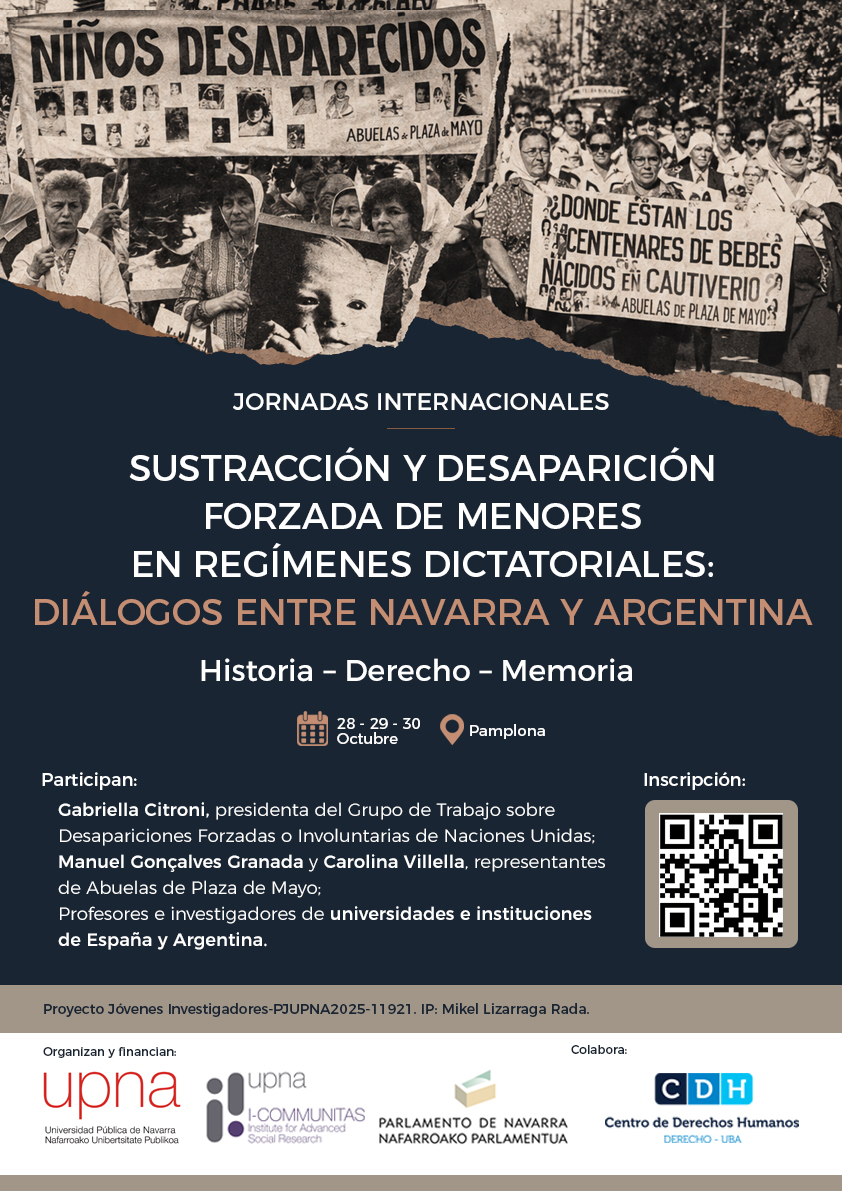
Child abduction and enforced disappearance under dictatorial regimes: dialogue between Navarre and Argentina
History – Law – Memory
The conference was organised by the Public University of Navarre, I-Communitas — Institute for Advanced Social Research and the Parliament of Navarre, with the collaboration of the Human Rights Centre of the University of Buenos Aires (CDH-UBA). It was directed by Mikel Lizarraga Rada, a lecturer in the History of Law and Institutions at the Public University of Navarre. The Red Interdisciplinaria Iberoamericana de Investigadores e Investigadoras (RII/INS) helped publicise it.
The event examined child abduction, enforced disappearance and appropriation under the Spanish and Argentine dictatorships and their consequences for victims and their families. The dialogue between the two contexts explored mechanisms for restoring identity, judicial responses and policies on truth, justice, reparation and memory, including their application and limitations in Navarre and Spain.
As set out in the UPNA’s official programme, also available as a complete programme in PDF, the sessions were organised into four parts:
- Children, women and repression. The historical context, child appropriation and the repression of women and motherhood under the dictatorships.
- Law and victims. Responses under international, European and Spanish law to enforced disappearances and irregular adoptions, and the possibilities for recognition and reparation.
- Truth, justice and memory. Argentine mechanisms for searching and restoring identity, judicial action and memory policies, in dialogue with measures adopted in Navarre and Spain.
- Victims’ testimonies. The final panel, featuring people directly affected and relatives, brought their experiences into the conference’s historical, legal and institutional discussion.
Participants included specialists from Spanish and Argentine universities, representatives of Abuelas de Plaza de Mayo and CoNaDI, and Gabriella Citroni, Chair of the United Nations Working Group on Enforced or Involuntary Disappearances. The aim was to connect academic research with public institutions and victims’ organisations, with the participation of those directly affected.
On 28 October, a screening of the documentary ¿Quién soy yo? and a round table took place at Salón Pinaquy; on 29 October, sessions were held in Annex 04 of UPNA’s El Sario building; and on 30 October, at the Parliament of Navarre. The presentation published by the Spanish Society for the History of Law also explains the event’s approach and scope.
The victims’ testimony panel
On Friday 30 October, at the Parliament of Navarre, the testimony panel formed the fourth and final part of the conference.
Following the historical, legal and institutional sessions, this panel brought in the experiences of people who had been taken as children and of families who continue searching. It provided a space for them to speak about the consequences of what happened, the processes of searching and recovering identity, and the need for recognition, justice and reparation.
The panel was moderated by Amaia Otazu, a journalist with Radio Nacional de España, and brought together the testimonies of:
- Fanny Erro, representing AMALUR — Asociación de Bebés Robados de Navarra, a mother searching for her first daughter, who was taken after birth.
- Beatriz Mahave Salcedo, also representing AMALUR, an adopted person searching for her original family.
- Soledad Luque Delgado, president of “Todos los niños robados son también mis niños”, who is searching for her twin brother Francisco.
- Manuel Gonçalves Granada, a victim of child appropriation during the Argentine dictatorship, secretary of Abuelas de Plaza de Mayo and a representative of CoNaDI.
- Olmo Gómez Aldaz, a victim of abduction and illegal adoption whose judicial recovery of his original parentage is directly connected to Navarre.
Olmo Gómez Aldaz’s participation
After learning about the conference, Olmo Gómez Aldaz located its director, Mikel Lizarraga Rada, and contacted him to share his story. It was through that contact that Mikel first learned of his case, which sparked considerable interest. After speaking by telephone, he invited Olmo to take part in the victims’ testimony panel.
His experience has a direct family and judicial connection to Navarre. His original family is from Navarre, and the courts in Navarre recognised his original paternal parentage through a judgment of Court of First Instance No. 9 in Pamplona, upheld by the Provincial Court of Navarre on 12 May 2025.
The recovery of his original parentage and surnames while retaining his adoptive parentage, together with his official recognition as a victim of Francoism, brought a concrete experience to the conference of both the progress achieved and the questions of reparation that remain unresolved.
His participation also coincided with his joining AMALUR.
Recording of the panel
Victims’ testimony panel · · Parliament of Navarre
The recording of the afternoon session lasts 2 hours and 29 minutes and can also be watched in the Parliament of Navarre’s official media library.